Queens

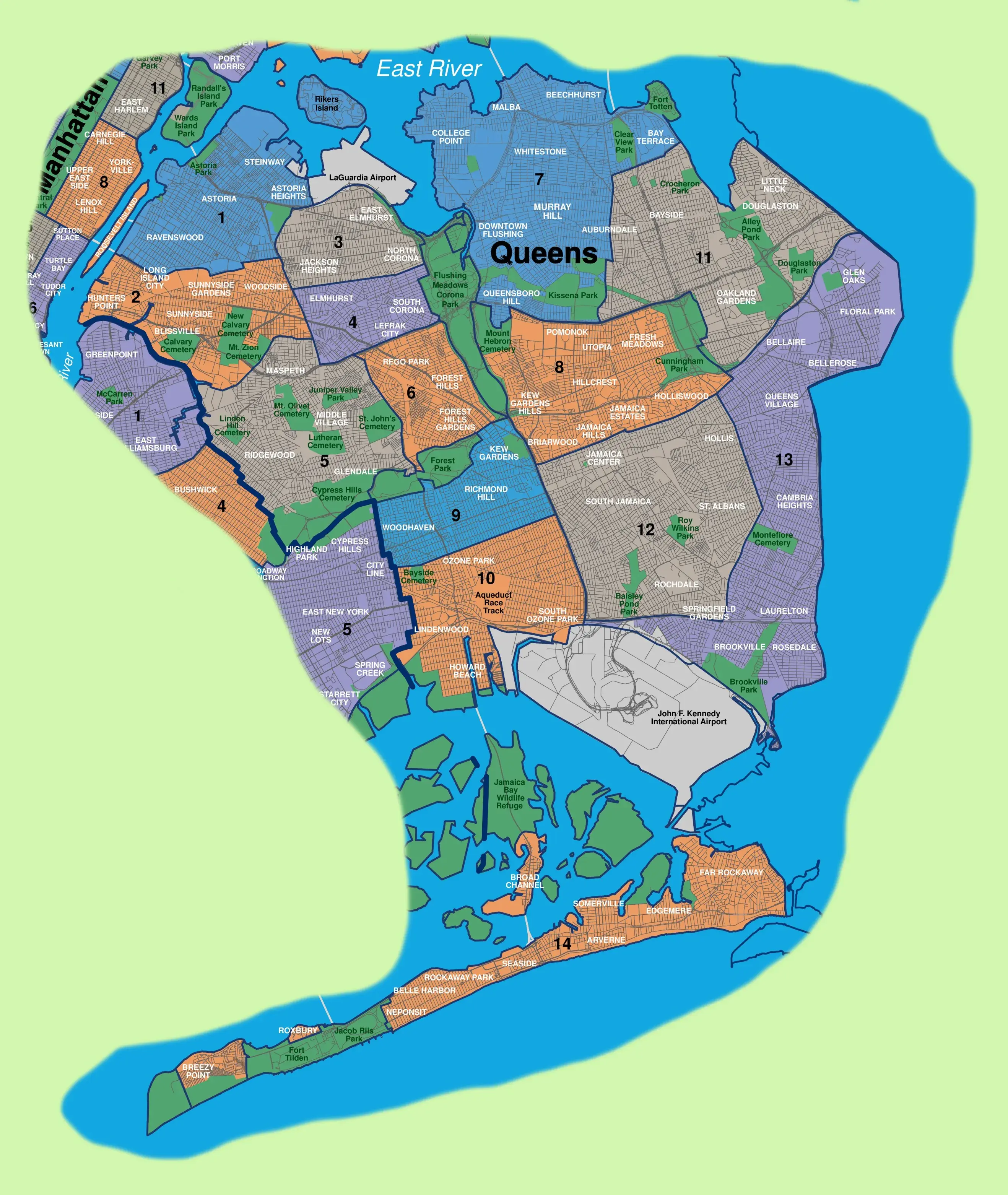
All of the outer boroughs have their ethnic elements, but Queens is the most diverse of all of them. With neighborhoods like Astoria (Greek and Italian), Sunnyside (Turkish and Romanian), Jackson Heights (Hispanic and Indian) and countless others, Queens is the quiet borough “for everyone else.” It’s not as glamorous as Manhattan or as brutal as the Bronx or as populous as Brooklyn, but its character comes from its unique cultural blend. In the nights to come, many Kindred will probably find themselves establishing havens in Queens, whether out of affordability or a chance to claim some of the overlooked but worthwhile domains in the borough.

Flushing

Flushing, Queens - Wikipedia
Bordered by Bayside Avenue to the north, the Flushing Meadows-Corona Park to the west and Union Turnpike to the south

Even during the Sabbat’s dominance of New York City, Flushing had slowly but surely exhibited the same cultural gravitation as so many other neighborhoods. By the end of the 1980s, Flushing was mostly Asian, with a good 20 percent of its population hailing from Korea and another 20 percent immigrating from China (Taiwan). While this served as a core for many of the Asian gangs that were part of the Sabbat, the Camarilla has been slow to exploit the territory to the same degree the Black Hand did.

It is rumored that, a few independent Assamites have established minor domains in Flushing, waiting on the word of Wise Frog to come forth. A small enclave of Asian Malkavians is rumored to have made Flushing its haven, but little more has happened. In the nights to come, if the anarchs don’t push north into the Bronx, they may well move northeast into Queens, drawing new revolutionaries from the residents of Flushing.

John F. Kennedy Airport

John F. Kennedy International Airport - Wikipedia
In southeastern Queens, on Jamaica Bay

While the airport itself is considered to be open to all Kindred, the place abounds with Giovanni contacts, spies and even family members behind the gates. To date, the Giovanni have avoided making any grand claim of domain over the airport, but anything out of the ordinary going on there eventually makes it back to their ears through their network of agents. While this normally doesn’t make much difference, it can be a tremendous asset to the Necromancers. For instance, if a shipment of contraband goes through JFK, the Giovanni would be more than likely to ask for a share, lest news of the information make it to a vigilant customs official’s voice mail.

The Giovanni are very careful with Kennedy Airport not to bite off more than they can chew. Most of the time they work through proxies, ghouls and mortals, “losing” a cargo shipment for a Kindred who refuses to pay tribute or arranging a flight delay for a truculent Kindred so that his plane would land during daylight hours.

If a dedicated group of Kindred attempted to wrest the airport from the Giovanni’s sphere of influence, it would be possible due to the restricted manpower of the Necromancers, but they might find themselves running afoul of problems elsewhere. Were the Giovanni to lose their influence at JFK, their power would be signifiantly inhibited. Their resources are already stretched to the limit, and by the time they were able to cultivate Newark or La Guardia, another Kindred or a consortium of vampires would likely already be there. Of course, that same principle applies to Kindred attempting to usurp Kennedy Airport from the Giovanni — unless they know that the Necromancers have put all their eggs in one basket and are attempting to cripple the Necromancers, they’d probably face less opposition by pursuing influence at one of the other airports.

P. S. 1 Contemporary Art Center

MoMA PS1 - Wikipedia
Jackson Avenue and 46th Avenue

While the relatively sedate borough of Queens doesn’t immediately lend itself to the high-society atmosphere usually associated with the Toreador, the Degenerates nonetheless have a stake in the borough’s affairs. P.S. 1 is a former public school converted into an art gallery, performance venue and studio space. During the summer, P.S. 1 hosts live music performances, DJs, festivals and other events designed to involve the community in the realm of artistic expression. The museum is also affiliated with the Museum of Modern Art (just two stops away by subway).

Toreador interest in the P.S. 1 Museum focuses mainly on the community involvement aspect of the art center’s mission. While a few effete Toreador embody the worst stereotypes of the clan, harping on this art darling or that socialite’s obnoxious refusal to attend some show or another, those on the forefront of the Camarilla’s stabilization effort have a different reason for patronizing the arts. Quite simply, as the ebb and flow of mortal trends are vital to the Toreador unlifestyle, the Degenerates in New York have bought into these mortal institutions from the ground floor. While individual Toreador may have their own personal agendas, most of them agree that political power rests with those who have the greatest collective power — a sort of Kindred version of the popular vote, by which a vocal contingent of undead can affect policy with sheer numbers. While the Toreador aren’t the most numerous clan in New York, they can certainly be the most vociferous.

For this reason, the Toreador have made P.S. 1 the epicenter of their cultural power base. Everyone has left their understood bailiwicks (such as the Museum of Modern Art and the Metropolitan Museum of Art) alone and expects them to focus on high-glamour Manhattan. By starting with the outer borough and moving into Manhattan, the Toreador may well stand unresisted, possibly assuming the greatest bloc of power in the whole city… if they can hold themselves together long enough to use it aptly.