Brooklyn

Brooklyn - Wikipedia

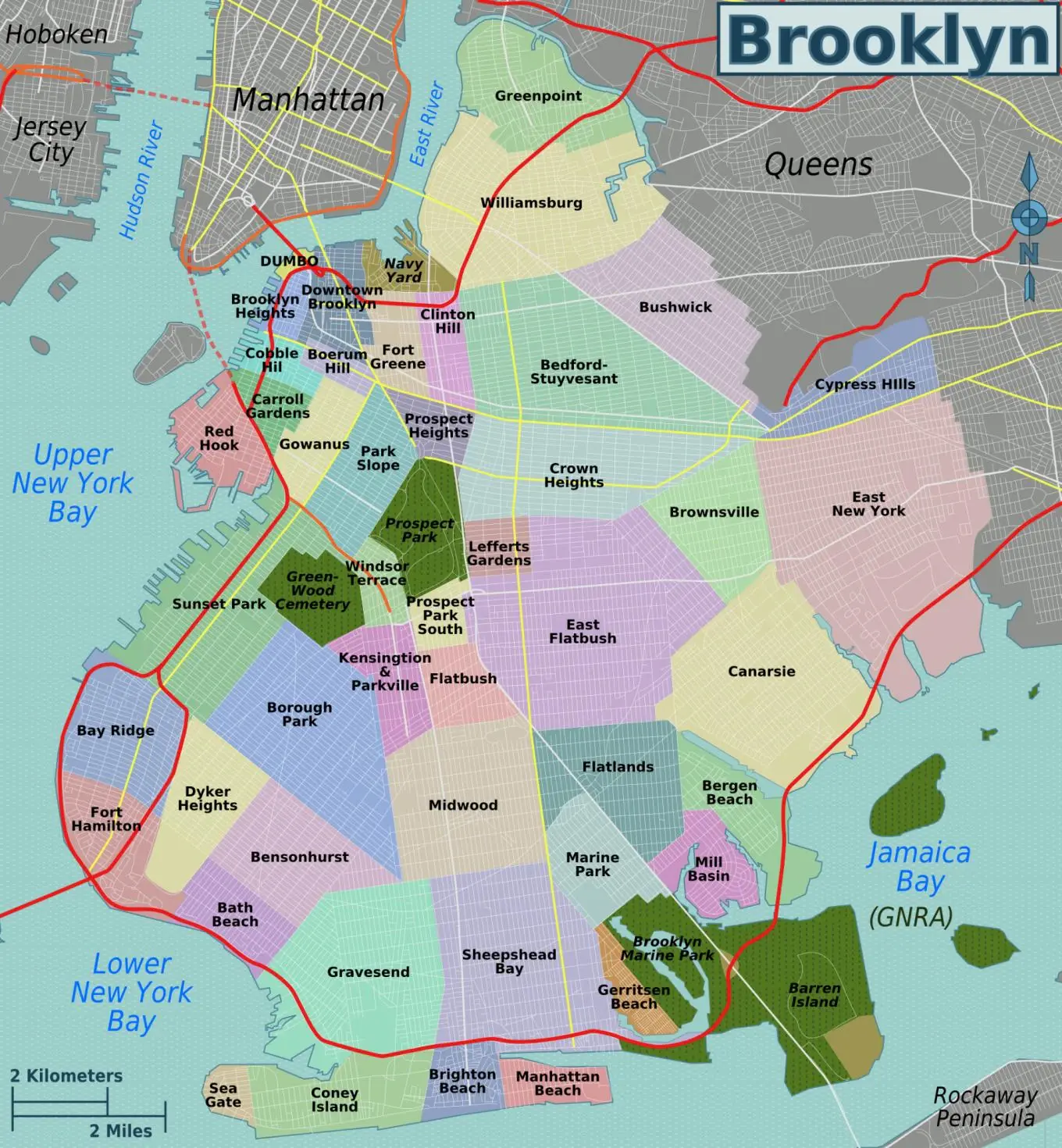
The most popular of the outer boroughs, Brooklyn is also the most diverse when it comes to Kindred matters. It seems that Brooklyn has something that appeals to Kindred from all walks, from the easy feeding in its less savory neighborhoods, to rising property values for those with havens or investment on their minds, to the presence of numerous cultural landmarks such as the Brooklyn Academy of Music and the Brooklyn Public Library. Virtually any Kindred could find something of interest in Brooklyn - as the rapidly vanishing domains represent.

Coney Island

Coney Island - Wikipedia
At the southeastern tip of the Brooklyn borough

Originally named Konijn Island after the Dutch word for the wild rabbits that lived there, Coney Island was for a long time synonymous with resort and amusement culture. In the modern nights, that reputation is a thing of the past, and Coney Island’s boardwalks suggest decrepitude more than grandeur and depression rather then wonder. Still, the amusement attractions on the island trudge along, from one of the oldest Ferris Wheels in the country to the crumbling “seaside resorts” renting no-questions-asked rooms for a few dollars per night.

Coney Island is predominantly Brujah territory, with an appreciable demographic of Malkavians and Toreador as well. The Brujah are largely ethnic here, with Russians hailing from neighborhoods like Little Odessa. Indeed, under the Sabbat, Little Odessa was considered the domain of Oleg Selivanov, a Tzimisce with connections to the Russian Mob. When the Camarilla swept in, Selivanov found himself displaced by the Brujah, who threatened to sell him to his rival in Philadelphia if he ever showed his face in the erstwhile Brighton Beach again.

The Ravine

Prospect Park (Brooklyn) - Wikipedia
At the center of Prospect Park

While the Gangrel had nominally been “given” Van Cortlandt Park in Manhattan, few of them actually avail themselves of the domain. Most simply make their domain where they choose to, and the Ravine is an example of this “where I hang my hat” haven philosophy. The Gangrel Jezebelle and her small brood make their haven at the densely wooded center of Prospect Park.

The Park itself is one of the most beautiful in the city, having been designed by the same planners who designed Central Park. It’s a much more organic creation, untarnished by skyscrapers and unmarred by streets. The park includes rolling hills, winding walkways and expanding meadows that seem to emerge from nowhere. Prospect Park is also a bit more appealing to the Kindred because it’s not infested with Lupines, as Central Park is rumored to be. At its center is a copse of trees, which currently lie behind fences erected for the renewal project currently underway. Here, the Gangrel make their havens, hiding in undeveloped parts of the wood during the day or simply sinking into the ground when they can’t be sure their daily rest will go unmolested.

Cobble Hill

Cobble Hill, Brooklyn - Wikipedia
Bordered on the north by Atlantic Avenue, on the east by Court Street and on the west by the Brooklyn-Queens Expressway

Cobble Hill was originally an upper-middle class neighborhood in northwestern Brooklyn, composed of Romanesque brownstones, erected during the late nineteenth century. A few housing projects grew up around that time as well, much to the dismay of the more affluent residents. Urban renewalists enamored of the brownstone designs moved in and “reclaimed” the neighborhood from the lower-income families, organizing an effective resistance against the public housing effort by having the neighborhood declared a historic district in 1969. Since that time, property values have increased. Once again, Cobble Hill is an upper middle-class neighborhood, bordering on the affluent.

As a result of renewal projects and rising property values, Cobble Hill is the domain of a small group of Ventrue and Toreador. As with other neighborhoods, the population can’t sustain the Kindred who dwell there, but they have no problems feeding elsewhere and returning at the end of the night to their pleasant havens.

Bedford-Stuyvesant

Bedford–Stuyvesant, Brooklyn - Wikipedia
Bordered on the north by Flushing Avenue, on the east by Broadway and Saratoga Avenue and on the south by Atlantic Avenue

New York’s largest black neighborhood, “Bed-Stuy” has a reputation it doesn’t deserve. While poverty does exist and some of the public housing is deteriorating, many of the neighborhood’s brownstone homes are in fine repair and owned by middle-class families. Despite this, Bed-Stuy’s notoriety as a slum persists. The neighborhood is about 85 percent black, with ethnic populations from Jamaica, Trinidad and Haiti. A significant minority of the neighborhood is Latin American.

The complications of Bed-Stuy’s reputation have influenced the neighborhood’s status as domain, as one might suspect. A small group of Setites claims that it has always been there, though during the Sabbat occupation of the city, Bed-Stuy was “shared” by a Lasombra and a Tzimisce. Several Brujah feel a connection to the neighborhood, as do a few Toreador, due to its rich ethnic and cultural heritage, as embodied by such places as the Billie Holliday Theater and Boys High School (attended by Isaac Asimov and Norman Mailer). Ventrue and Tremere investors see long-term potential in the neighborhood, especially with the continuance of the Society for the Preservation of Weeksville and Bedford-Stuyvesant History, and the Bedford Stuyvesant Restoration Corporation. To that end, while everyone has some interest in the neighborhood, no one has been able to make a claim of domain that the others dignify with recognition.