The Bronx

The Bronx is known for several popular landmarks: Yankee Stadium, the New York Botanical Garden, the world-famous Bronx Zoo. It is also, however, a national symbol of urban decay, a reputation that eclipses its component neighborhoods and contributions. Like the other outer boroughs, Bronx grew populous first as a collection of ethnic neighborhoods and then as a result of extremely high rents in Manhattan. As a result, the Bronx is a patchwork of ethnic divides, low-income housing projects, collapsing tenements and, amid them, a few shining examples of the potential the borough once had.

Munsee-Hudson Expediting and Storage

Henry Hudson Parkway and 254th Street

A queer companion to the vacated Grand Central sanctum in Manhattan, the offices of the Munsee-Hudson Expediting and Storage Company served as the last stand for the organized forces of the Sabbat. Owned by a consortium of Lasombra and used as a haven and weapons cache by Archbishop Polonia, the small complex stands abandoned tonight. The central building that once housed the offices of the shipping company has been ransacked innumerable times by gangs of both Kindred and kine, and graffiti adorns many of the walls. The grounds themselves are littered with rectangular metal storage containers, some stacked high off the ground, others arranged haphazardly. Here and there, piles of greasy ash may be found, eternal testaments to the secret war that occurred here, far from mortal eyes, during one of the most decisive conflicts of the battle.

Munsee-Hudson has a reputation for being haunted, though by what, exactly, tales rarely agree. Some speculate that it’s still a hideout for Sabbat resistance fighters, or that they meet there to conduct rites of loyalty. Others say that the ghosts of those Sabbat Kindred killed on the fourth night of the battle plague the place. While none of these are true, the rumors serve to keep curious Kindred away from the site.

Of course, the complex’s scorned reputation makes it a perfect place for an enterprising group of young Kindred to make their own haven. It would be suitable for Nosferatu who eschew the sewers, or it would be a perfect place for a criminal coterie to set up shop, whatever their “industry” might be.

Interested Kindred who want to establish a haven there might have a bit of competition, however. The anarch presence of New York, brusquely swept to Staten Island in the wake of Camarilla victory, has also been searching for a way to establish itself in the central part of the city. A few of the anarchs probably participated in some aspect of the Battle of New York (either as anarchs or prior to joining them) and may well remember the fight at the storage yard and recommend it to leaders among the faction.

Add to the possibility of contention the fact that Polonia and his sectmates constructed numerous traps throughout the facility’s grounds. Several of these might remain in operating condition. Hazards such as storage containers rigged to topple; rude shrapnel bombs containing broken glass, rusty nails and other debris set to invisible tripwires; even dens of hungry or rabid dogs: All of these and more might await a coterie or pack scouting this potential haven.

Belmont

Belmont, Bronx - Wikipedia
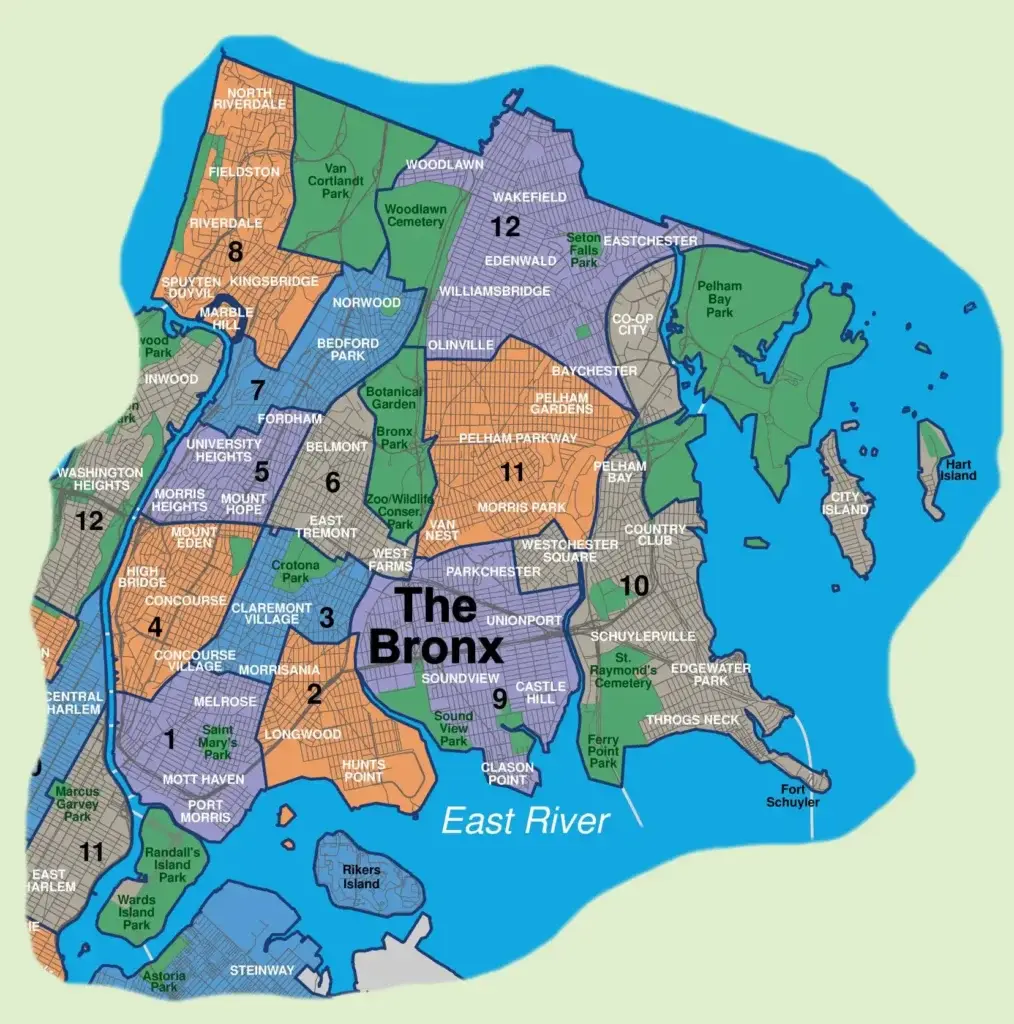
Bordered by Fordham University to the north, the Bronx Zoo to the east and Tremont to the south

While most divisions of Kindred happen along clan lines, sometimes they occur in other distinctions. The neighborhood of Belmont is one of these domains. Known as the “Little Italy of the Bronx,” Belmont is home to a few Italian and Italian-American Kindred, mostly from Clans Brujah and Ventrue. While the population of Belmont is too small to support the feeding habits of these Kindred, they have little problems going elsewhere in the city to fulfill those needs. In fact, Belmont is as much like a “Kindred neighborhood” as the undead observe, with havens being well kept and largely indistinguishable from the other homes of the neighborhood. While simply being neighbors hasn’t made the Belmont Kindred into the best of friends, it at least encourages them to resolve the differences that do arise.

Note that despite the Italian ethnicity of Belmont, no Giovanni make their havens here. Whether this is because of a Kindred issue or a cultural one is unknown, but little love seems to be lost between the Necromancers and the vampires of this neighborhood.

South Bronx

South Bronx - Wikipedia
Mott Haven, Bronx - Wikipedia
Hunts Point, Bronx - Wikipedia
Castle Hill, Bronx - Wikipedia
Mott Haven, Hunts Point and Castle Hill neighborhoods

Much like Morningside Park in Manhattan, South Bronx has always belonged to the Setites. The neighborhoods are predominantly black and Puerto Rican in the modern nights, and the low-income housing projects in these neighborhoods provide no small amount of black-market income to the Serpents. Between Hunts Point and Castle Hill, the Setites also have an appreciable domain over the Bronx-side East River. They’ve extended the use of this domain to others before, particularly a few Sabbat who wanted to escape the wrath of the Camarilla and a handful of criminally aligned Camarilla Kindred who don’t want to offer the Giovanni part of their profits. If anyone wants to get in or out of New York without being seen, dealing with Bronx Setite posses is a fine way to do it, as they don’t have the growing relationship with the Camarilla that the Giovanni do, and they’re not claimed as domain by Camarilla vampires themselves.

Mott Haven is characterized by rows of high and low rise public housing, and the several of the Setite-dominated gangs and posses make their homes here. While poverty, ethic ghettoes, and drug traffic, are still the norm here for the Setite gangs, the neighborhood has recently become a “Renaissance neighborhood,” with an increasing number of middle-class black families buying row houses and renovating them, driving the property values (and thus the rents) up. It would seem that the Setites are of divided opinions on this — some have taken the opportunity to invest themselves while others see the reclamation of the neighborhood as a threat to their tried and true streams of infl uence and resources.

The Hunts Point neighborhood has been predominantly black and Puerto Rican since the populations of those ethnicities surpassed the numbers of the previously numerically superior Jews (with enclaves of Germans, Irish and Italians). Another district of tenements and projects, Hunts Point was originally known for its high-quality apartments, but by the 1960s, even these had begun to deteriorate. Hunts Point has a juvenile prison, which Setites occasionally frequent for vitae, and an industrial sector, through which shipments of contraband are sometimes received. The Hunts Point Market, which sits on a piece of land extending into the East River, is one of the largest markets of its kind in the world, selling over a billion dollars a year in produce. This includes the terminal market’s sales of fruits, vegetables and meats, as well as the meat market cooperative and the various food warehouses that distribute some 60 percent of the food consumed by the entire metropolitan area. When the wholesale merchants who ran the market acquired it from the city in 1986, many Setites saw a chance to buy in and did so, supplementing their illicit gains with legitimate profi ts garnered by affiliated vendors.

Housing projects built on empty lots appeared during the 1960s in the Castle Hill neighborhood. The Setites followed this wave of housing construction over from their other neighborhoods, which went largely unchecked by the Sabbat, as South Bronx had traditionally been Setite domain.

Rikers Island

Rikers Island - Wikipedia
Off the southeastern tip of the Bronx, in the East River

It may seem that a prison island would have little to offer the Kindred. In cases of desperation, the opposite is true. The Malkavian Carter Vanderweyden has numerous contacts at the island, obtained through his past profession as a lawyer. Carter has arranged a system of bribery and blackmail with several of the Rikers guards and officials. Almost any time he needs entrance, he can obtain it, or extend it to a “representative” of his. As such, Kindred who need blood but have been forced to lie low have occasionally gone to Carter, trading prestation for vitae. Additionally, prisoners who know too much about the Kindred can usually be silenced. Agents of Kindred opposed to Vanderweyden (or his allies… or anyone who extends him a boon, really) can also be dealt with herein.

Van Cortlandt Park

Van Cortlandt Park - Wikipedia
North Bronx, bordered on the north by the border of the borough itself

During the Sabbat’s tenancy in New York, Van Cortlandt Park was an indisputably Lasombra domain, extending back to at least the middle of the nineteenth century. Originally part of the Philipse family’s estate, the huge potion of land (1,122 acres) was presented as a dowry to the Van Cortlandt family at the end of the seventeenth century. When members of the Van Cortlandts were Embraced into the Sabbat, they brought part of their mortal properties with them as domain.

In the modern nights, however, after the fall of the Sabbat, the park went briefly unclaimed before being bestowed somewhat reluctantly to “the Gangrel.” This, one of Drakes’ less popular policies, drew much fire. Opponents claimed that with the Gangrel’s nonchalant attitude, that they could not be counted upon to put the best interests of the Camarilla ahead of their own, should the Sabbat strike back. Others saw it as a concession, by which the prince recognized the efforts of the Gangrel helped in the Battle of New York. Still others saw it as a hedge who believed it to be a method by which Drake could obtain favors from some “muscle,” should he need to call upon the Outlanders at a later time for business unsanctioned by the sect.

The Gangrel had for their part found this arrangement begrudgingly acceptable in a sort of "that's what we were going to do anyway" sort of way. They try to maintain a certain air of independence, still, any Kindred found up to no good in the vicinity of Van Cortlandt Park without the acknowledgement of a Gangrel who can vouch for them may be in for a bloody end.